
When One Class Rules
What the Ancient Indian Varṇa Model Reveals About the Present
Communism faltered when it suppressed enterprise and independent meaning. American capitalism now risks the opposite error: allowing the merchant ethos to subordinate workers and the common good.
The ancient Indian varṇa model is usually encountered through the history of caste. The caste system is a corruption of the Varna prophecy. The four Varnas are psychological profiles, not “castes” or classes as we understand them today. Blaming Varna for the caste system is like blaming the Bible for colonialism.
Used carefully, Varna can serve as something different: a lens for examining the distribution of power in society. In this interpretation, varṇa does not assign people hereditary rank. It identifies four recurring social capacities: the worker, the warrior, the merchant, and the intellectual-spiritual type.
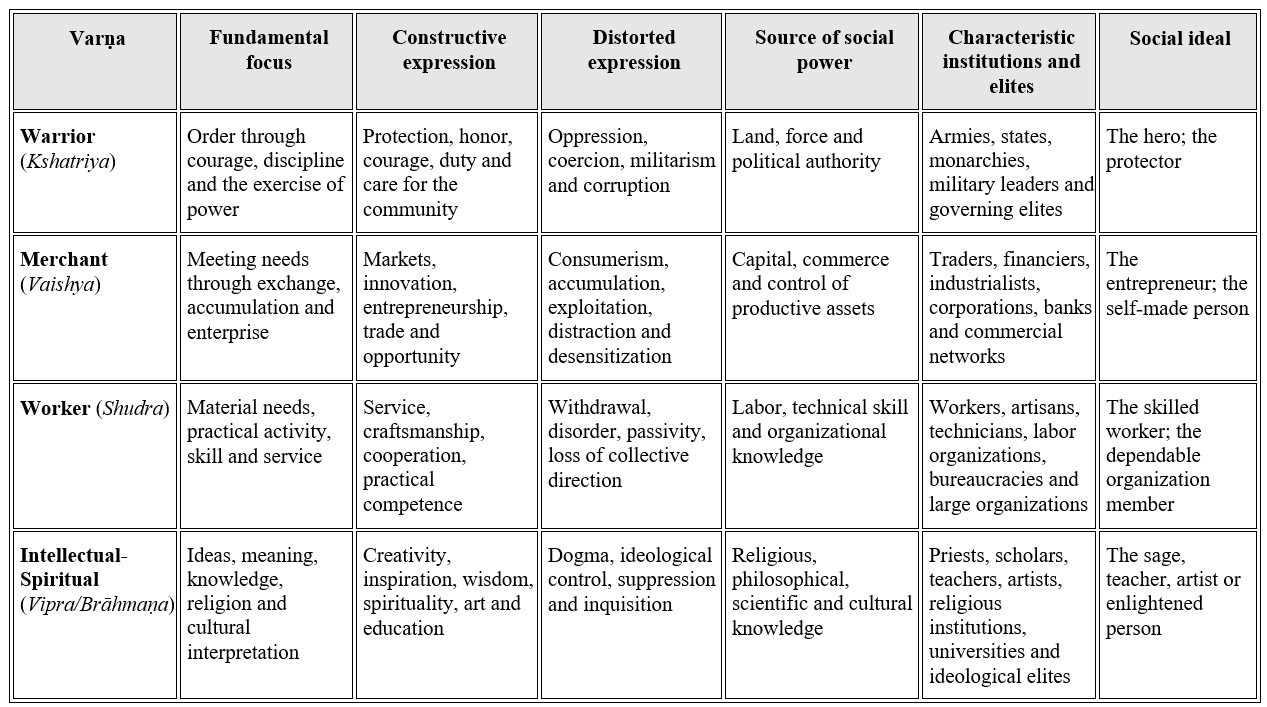
Workers produce, maintain, repair, and serve. Warriors protect society and enforce order. Merchants organize exchange, accumulate capital, and turn invention into enterprise. Intellectual-spiritual figures create meaning, knowledge, law, education, and moral orientation. Every complex society needs all four. The problem begins when one group suppresses the others or mistakes its own values for the whole of social life.
A model of imbalance
This is what makes the model useful in the present. It does not ask only whether a country is capitalist, socialist, democratic, or authoritarian. It asks which social function has acquired disproportionate power, which functions have been marginalized, and what kind of distortion follows.
Each varṇa has a constructive and destructive expression. Workers can embody skill, solidarity, and service, but exclusion can turn their frustration into withdrawal or disruption. Warriors provide courage, security, and public order, but unchecked warrior power becomes coercive. Intellectuals and spiritual leaders can educate and inspire, but they can also impose dogma. Merchants generate prosperity and innovation, but merchant dominance can reduce society to accumulation, consumption, and financial return.
The model therefore offers no perfect ruling class. Social health depends on balance. A society needs enterprise without allowing wealth to purchase government, authority without militarizing public life, knowledge without ideological monopoly, and work without reducing people to instruments of production.
What communism excluded
The Soviet Union and Mao-era China can be interpreted as attempts to construct societies around workers, at least in official ideology. Private capital was curtailed, major enterprises were placed under state control, and the merchant class was treated as a source of exploitation. Organized religion and independent intellectual life were also restricted because they could challenge the party’s monopoly on truth.
In practice, workers did not govern. A fusion of warrior and intellectual-bureaucratic power governed in their name. The party defined legitimate thought, the security apparatus defended the system, and state planners made economic decisions. By suppressing merchants, these systems weakened entrepreneurship, decentralized information, responsiveness to demand, and incentives to experiment. By suppressing independent spiritual and intellectual institutions, they also narrowed the space in which society could question its direction or articulate purposes beyond production and state power.
The consequences were not simply economic. Shortages and inefficiency revealed the limitations of planning, but the deeper problem was structural. One center attempted to perform all four social functions. Administrators became economic managers, ideological authorities, and guardians of political order at once. The system lacked counterweights.
China’s reforms after 1978 illustrate the point. The country did not abandon state direction, but it restored space for markets, private firms, investment, and commercial initiative. Private enterprise became a major source of output and employment. China’s subsequent rise was not the victory of pure communism. It followed the partial return of the merchant function to a system that had tried to eliminate it.[1]
Russia’s transition was far less orderly. When the Soviet structure collapsed, commercial power returned abruptly and was captured by a small group with privileged access to state assets. This was not a healthy balance either. The suppression of merchants was followed by oligarchic merchant power, while political authority reconsolidated around the state. The varṇa lens suggests that excluding a social capacity does not abolish it. It often guarantees that its eventual return will be distorted.
America’s opposite danger
The United States presents the inverse problem. It has benefited enormously from the merchant virtues: initiative, risk-taking, organization, innovation, and the ability to transform ideas into widely available products. Yet the merchant ethos increasingly reaches beyond commerce into politics, education, medicine, media, and personal identity. Institutions are judged by growth, market share, shareholder value, and measurable return.
Workers have not disappeared, but their bargaining power has weakened. In 1983, 20.1 percent of American wage and salary workers belonged to unions. By 2025 the figure was 10 percent. Meanwhile, the highest fifth of households received 52.2 percent of aggregate household income in 2024. These statistics do not prove that merchants literally rule America, but they are consistent with a society in which capital has acquired greater power than organized labor.[2]
The imbalance appears in deindustrialized regions, insecure employment, unaffordable housing, and the political invisibility of the people who maintain infrastructure, deliver goods, care for the elderly, and keep cities functioning. The worker is celebrated rhetorically but often treated economically as a cost to be minimized. Productivity gains and technological innovation become social achievements only when their benefits are broadly shared.
Merchant dominance also affects the intellectual-spiritual sphere. Universities, news organizations, churches, and cultural institutions increasingly compete for funding, attention, branding, and audience metrics. Knowledge becomes content; citizens become consumers; personal development becomes a market. The issue is not commerce itself. It is the extension of commercial valuation into areas whose purpose cannot be captured entirely by price.
Balance vs Exclusion
Indian spiritual teacher Sarkar and American futurist Larry Taub interpreted the varṇas as historical cycles, but the model can also be used as a lens or even as a diagnosis of simultaneous forces. Modern societies contain all four types at once. Their task is not to replace one ruling group with another, but to build institutions that prevent any group from becoming absolute.
That means strengthening workers through skills, bargaining power, ownership, and dignity; directing merchant creativity toward productive rather than purely speculative investment; subjecting warrior power to law and democratic accountability; and protecting intellectual and spiritual life from both state censorship and total commercialization.
The varṇa model does not provide a policy program. Its value is as a warning about monocultures of power. Soviet communism tried to build a society without merchants and independent spiritual authority. Contemporary America risks building one in which merchant values set the terms for everyone else.
A durable society is not one in which workers defeat merchants or spiritual leaders displace warriors. It is one in which service, protection, enterprise, and meaning remain in creative tension. The question the varṇa model asks of the present is therefore simple: not which class should rule, but what happens when any class forgets that it is only one part of the whole.